One-step object-effect removal

TurboClear

One-Step Object-Effect Removal via Region-Calibrated Distribution Matching and Fusion

Jiawei Guo1, Junxian Li1, Yixin Tang1, Bingya Zhang2, Jiaxin Lu2, Yulun Zhang1,†, Shangchen Zhou3,†

1 Shanghai Jiao Tong University 2 Honor Device Co., Ltd 3 Imperial College London

Corresponding authors

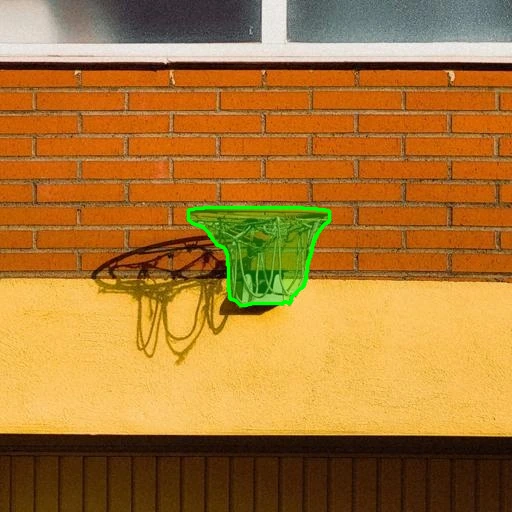
Remove the target object, its shadow, reflection, and other visual effects in a single denoising step while keeping unaffected regions intact.

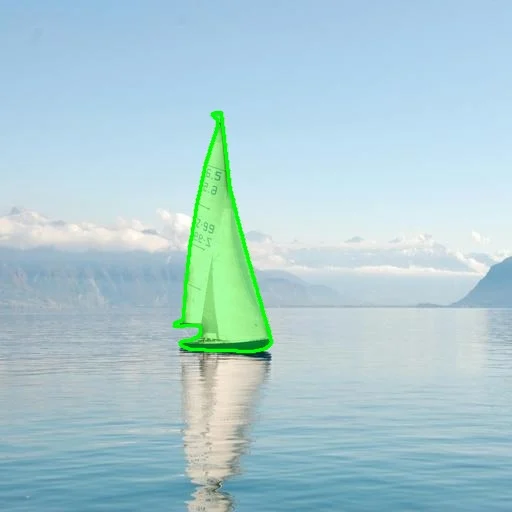
Calm lake after TurboClear removes a sailboat and its reflection
Sailboat and reflection selected with a green mask
Input + mask TurboClear
Desert landscape after TurboClear removes a person and the cast shadow
Person and cast shadow selected with a green mask in a desert
Input + mask TurboClear
Lake landscape after TurboClear removes a bridge and its reflection
Bridge selected with a green mask over a lake
Input + mask TurboClear

Drag each divider to inspect the input and result.

1denoising step
1.589 Tdenoising FLOPs on OBER-Test
40.04×less computation than ObjectClear
665×less computation than OmniPaint

Why TurboClear

Edit what matters. Preserve what does not.

Object removal must reconstruct areas influenced by the target while leaving unrelated content unchanged. Generic one-step objectives do not explicitly model this spatial asymmetry, which can leave residual effects or introduce unnecessary background changes.

TurboClear couples Region-Calibrated Distribution Matching with Learnable Spatial Fusion. The resulting SDXL-based student preserves the teacher's asymmetric edit-and-preserve behavior while reducing iterative diffusion inference to one step.

Qualitative results

Objects disappear. Structure stays.

Examples selected from the qualitative comparison in the paper.

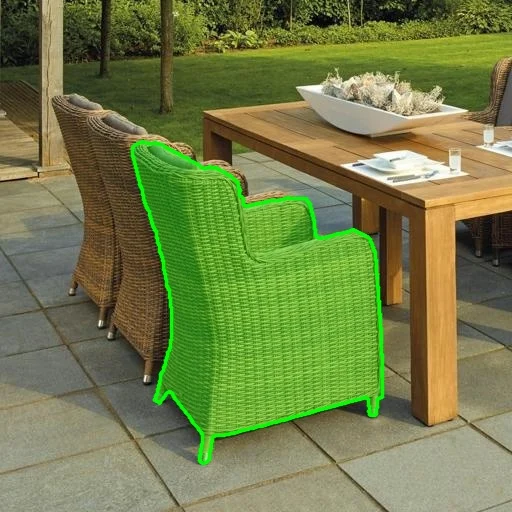
Patio after TurboClear removes a foreground chair
Foreground chair selected with a green mask on a patio
Input + mask TurboClear
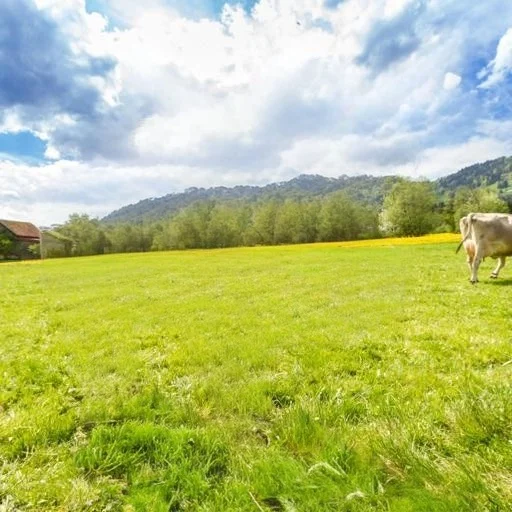
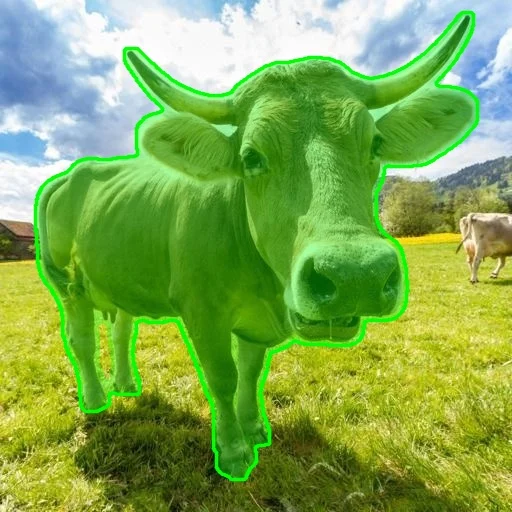
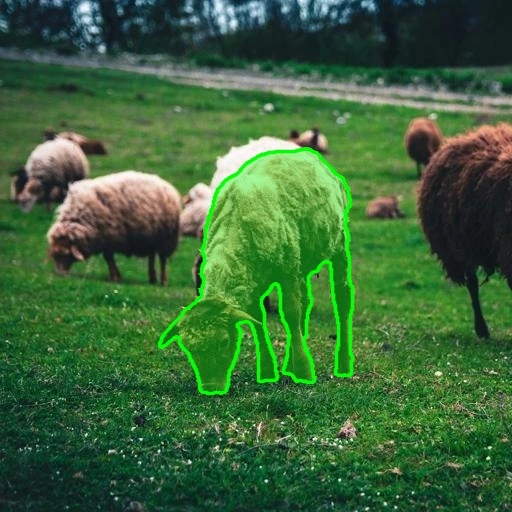
Open field after TurboClear removes a foreground cow and its shadow
Foreground cow selected with a green mask
Input + mask TurboClear
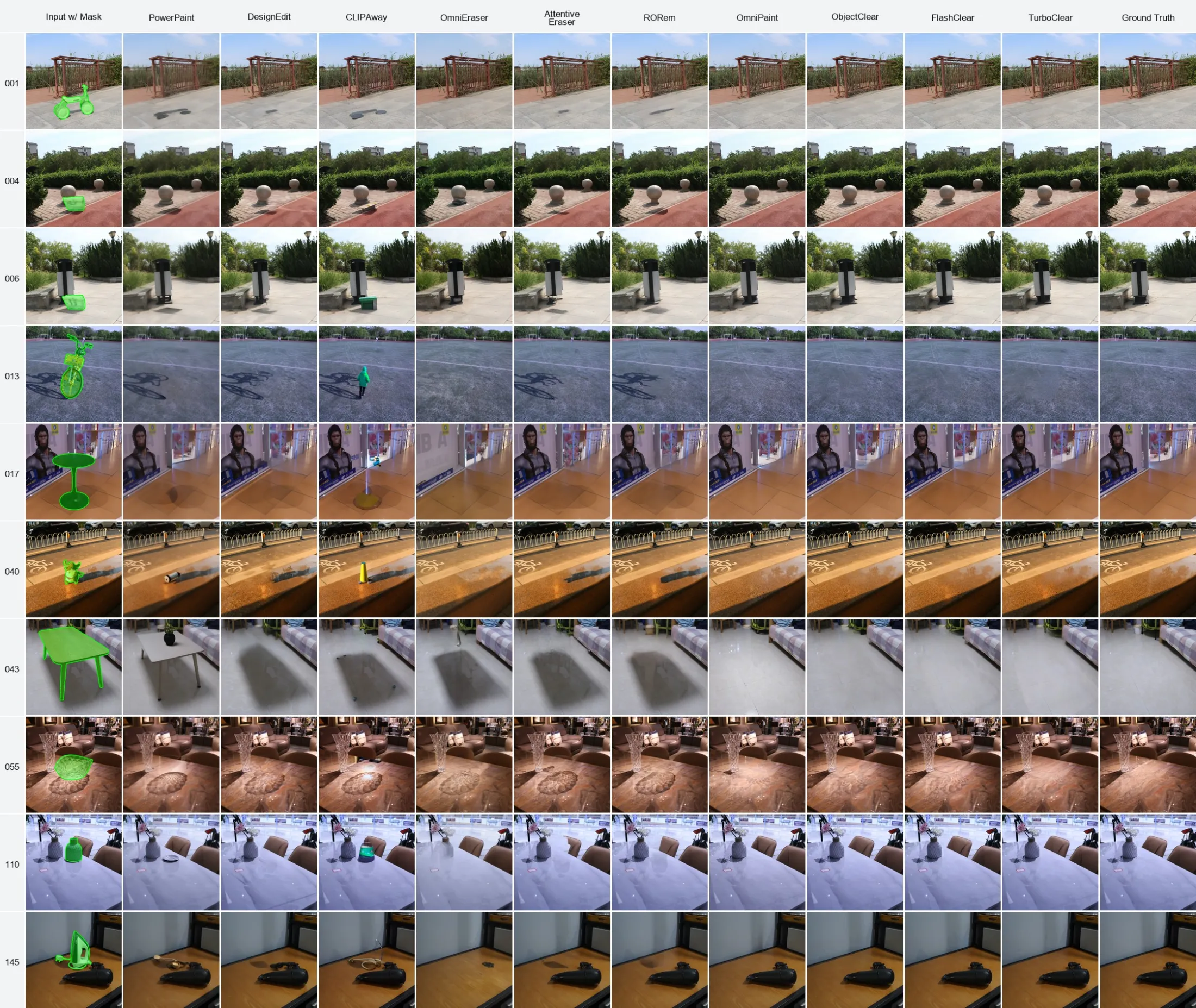
Full qualitative comparison of TurboClear and prior object removal methods
Extended comparison across representative OBER-Test examples. The complete figure is retained for detailed inspection rather than used as the primary visual.

Method

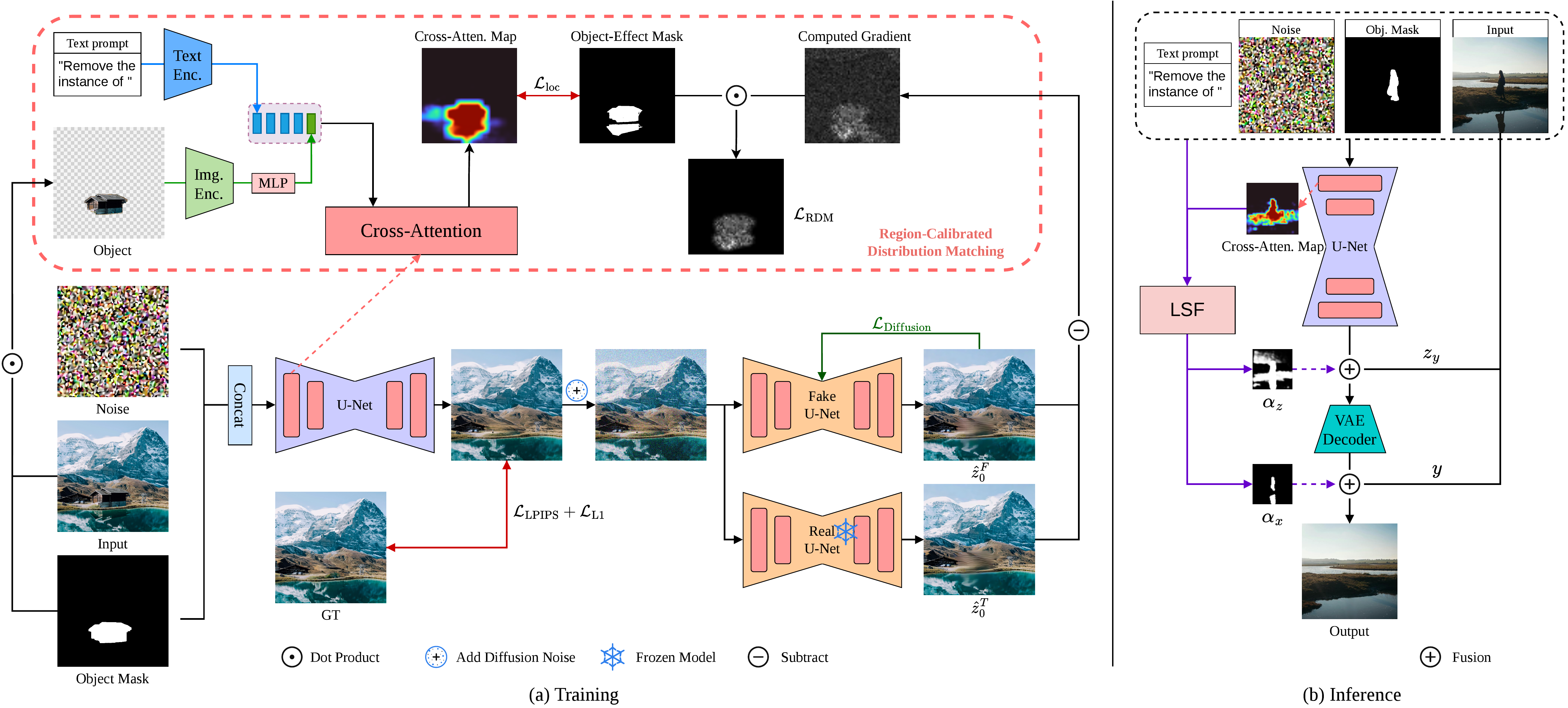
Region-aware distillation, spatially learned fusion

TurboClear training and inference pipeline with RDM and LSF
RDM calibrates distribution matching across affected and preserved regions during training. At inference, LSF predicts latent- and pixel-space gates to combine the generated output with the input stream.

Efficiency

Quality without the iterative cost

TurboClear reaches the strongest PSNR in the comparison while using substantially fewer denoising FLOPs than multi-step diffusion removal systems. Bubble area denotes model parameter count.
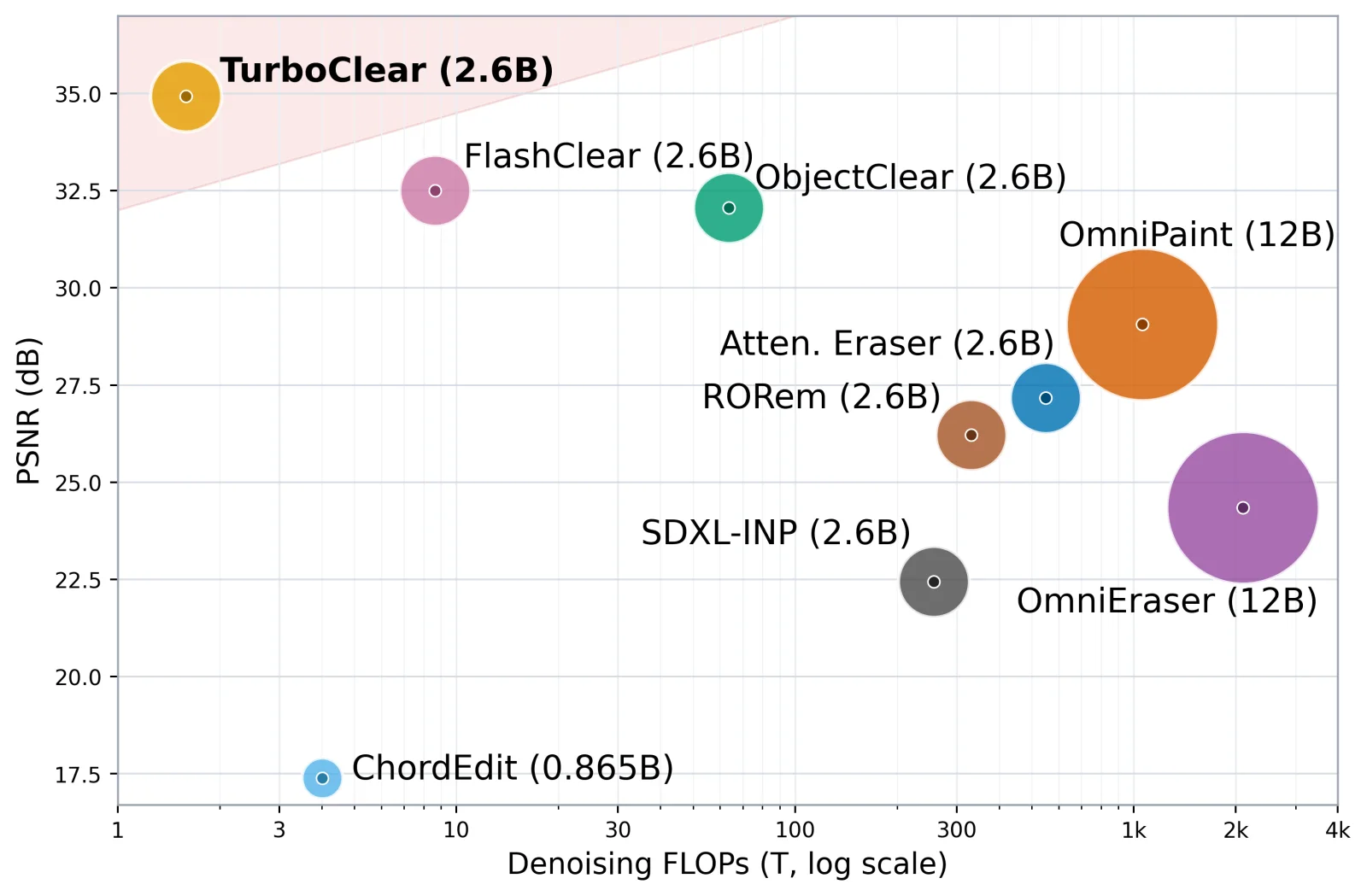
PSNR versus denoising FLOPs and parameter count for object removal methods

Citation

BibTeX

Please cite TurboClear using the following arXiv entry.

@article{guo2026turboclear,
  title={TurboClear: One-Step Object-Effect Removal via Region-Calibrated Distribution Matching and Fusion},
  author={Guo, Jiawei and Li, Junxian and Tang, Yixin and Zhang, Bingya and Lu, Jiaxin and Zhang, Yulun and Zhou, Shangchen},
  journal={arXiv preprint arXiv:2608.01288},
  year={2026}
}

Resources

Release status

Paper
arXiv:2608.01288
Model weights
TBD
Code
TBD
Usage guide
TBD